

Behind the name QC Terme, there is not just a spa chain, but a story that began in 1982 and grew into a leading name in Italian and international wellness.
Today, the QC Spa of Wonders group includes 12 spa centers, 8 hotels, 11 destinations, and 376 experiences, building the same promise everywhere: places able to convey wonder, balance, and elegance.
That is exactly why the project in Salsomaggiore Terme, in the province of Parma, had a special value.
It was not just about opening a new location, but about working on an iconic place like Palazzo Berzieri, a landmark building of the city, whose origins date back to 1912, as part of a redevelopment project covering a total of 9,000 square meters.
There was, however, one phase that needed to be handled with great care: the Renovation.
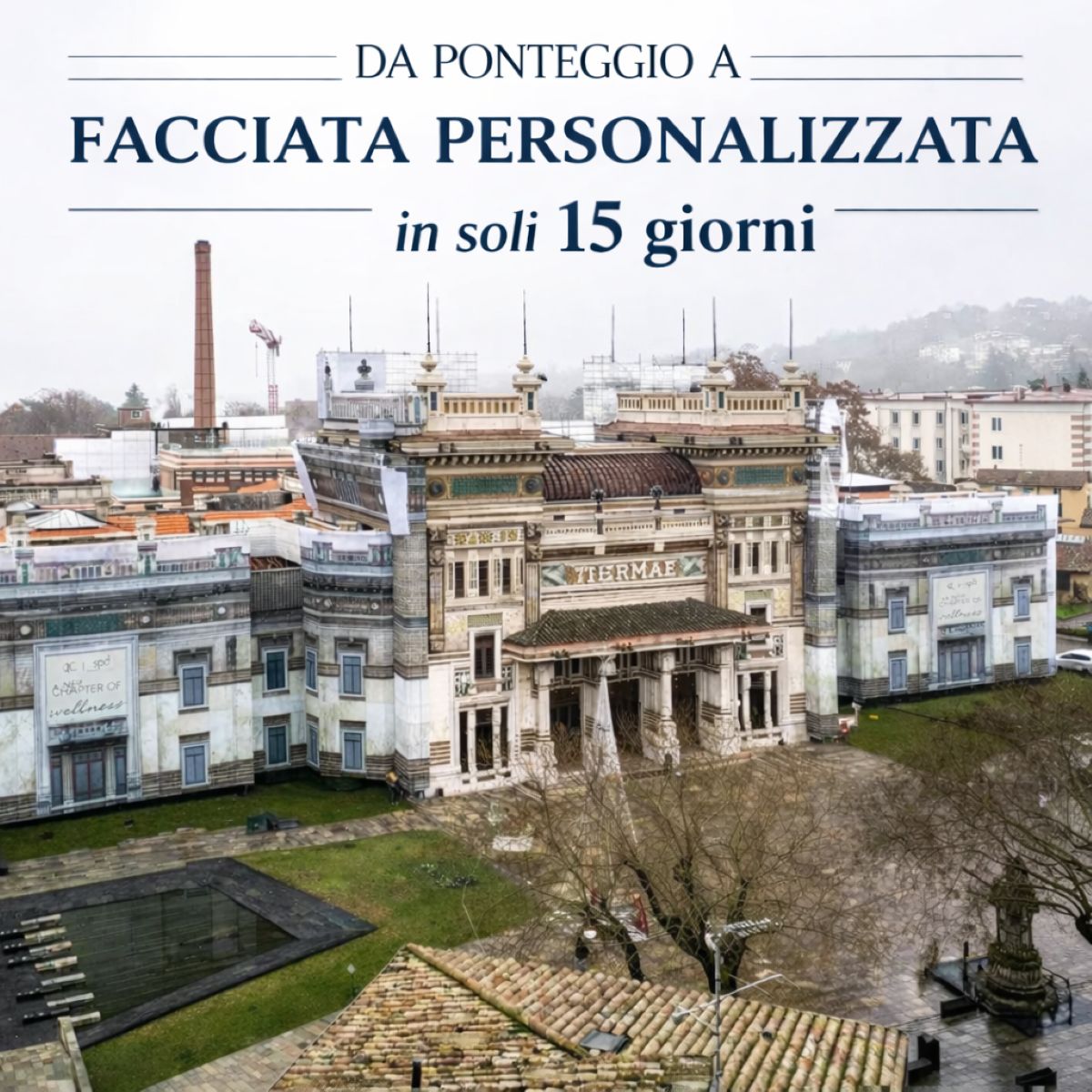
To work on a building of this importance, it was necessary to install a large scaffold, which would cover the entire façade of Palazzo Berzieri, including the entrance to the spa.
In a context like this, the problem was not only technical.
For a brand like QC Terme, allowing people to see behind the scaffold a construction site made of temporary structures, ongoing works, materials, and disorder would have meant showing an image that felt unpolished and far from its values.
The need, therefore, was very clear: it was not enough to simply cover the scaffold, it was necessary to protect the brand’s image during the works.
In such a visible area, visited and observed every day by residents, visitors, and potential customers, the external impact of the construction site also became part of the overall experience.
What made everything even more delicate was the fact that the construction site was constantly evolving.
Every change to scaffolding, measurements, and graphic drafts required continuous adjustments, without losing control of the final result.
To make things even more challenging, there was also a clear requirement from the client: to have every element ready in time for the opening day.
This made it even more important to work with care, flexibility, and consistency, without delays or last-minute solutions.
So, from the very beginning, it was clear that a simple supplier would not be enough.
What was needed was a partner able to manage a complex situation, adapt to the changes of the construction site, and turn a critical element, like the scaffold, into a more orderly, more reliable presence, more in line with the QC Terme brand.
An intervention built on listening and developed around the real conditions of the construction site.

The first contact with QC Terme came through one of our consultants.
From the very first discussion, we understood that this was not a standard request. For this reason, we did not start by showing ready-made products or pre-prepared solutions.
First of all, we chose to listen, because in a project like this it was essential to fully understand the context, the client’s expectations, the challenges of the location, and the level of attention required.
From this initial listening phase, one thing became clear: the project had to be built around the place and the brand, not around a ready-made solution.
So we decided to explore everything directly on site.
Site inspection
The site inspection in Salsomaggiore Terme was a key step.
Only by seeing the construction site in person was it possible to truly understand the visual impact of the scaffold, the views from the street, its relationship with the building’s façade, and the real risk that a poorly handled intervention could damage the overall image of the project.
After the site inspection, we understood even more clearly the client’s goal: to faithfully recreate the façade of the building that the scaffold would cover.
From that point, the next step was naturally the graphic design.
Graphic design

The graphic design phase was central to the whole project.
The goal was not simply to print a covering, but to reproduce the building’s façade in a realistic, harmonious, and coherent way, in line with its identity.
For this reason, the graphic design was developed starting from a real base. Our senior architect collected images and precise references directly on site, in order to create a design that was faithful to the existing architecture and planned for the final result once installed.
In a project like this, in fact, a simple rendering or an online reconstruction is not enough. What is needed is real orthophoto work, a photographic technique that makes it possible to reproduce the front façade of the building accurately and to work from a base that is much more precise and closer to reality.
But it was exactly at this point that the project showed all its complexity.
As often happens on real construction sites, the working conditions began to change: the measurements did not always stay the same, the scaffolding was modified, and some parts of the project were updated along the way.
As a result, the graphic design also had to be adjusted several times to stay consistent with the real conditions of the construction site. Every change required a precise update, always maintaining correct proportions, clarity, and visual accuracy.
For this reason, the work was also developed based on the technical scaffold project.
In this kind of context, it only takes a small mistake to lose precision, slow down the work, or compromise the final visual balance we were building.
From that point on, the project began to take shape in a concrete way: not as a simple site covering, but as a studied solution to “hide the construction site,” respect the context, and maintain outside an image that was orderly, credible, and in line with QC Terme.
Installation


At this point, QC Terme also faced an important decision: choosing the type of installation for the covering.
Quando si parla di teli da ponteggio personalizzati, le soluzioni principali sono due.
The first is direct installation on the existing scaffold. In this case, the covering is made to measure and fixed directly to the construction structure, without adding any other elements.
It is the simplest and also the most affordable solution. However, from a visual point of view, it does not allow a completely uniform cover and does not create that particular full-cover effect.
The second option, instead, is installation with a supporting structure. In this case, in addition to the existing scaffold, an extra structure is installed that extends out from 10 to 90 centimetres.
Its purpose is to support the covering, hide the edges, and create a much cleaner and more compact effect.
This creates the “gift wrap” effect, meaning a covering able to visually wrap the whole scaffold and make it look from the outside like a much more continuous, clean, and well-finished façade.
This is the more expensive solution, because it also requires the installation of the additional structure. But it is also the one that guarantees the best final result.
In the end, QC Terme chose the installation with a supporting structure, because it was the most suitable solution for achieving a more precise, more uniform, and more coherent result with the image of the building.
In a context like this, in fact, it was not enough to simply cover the scaffold: it had to be done in a tidy, compact, and visually reliable way, even in the eyes of people passing by outside.
The installation was carried out by a professional team, responsible for managing this phase with the necessary precision.
Precisely because of this type of installation, the coverings were also prepared with a dedicated finish, with more frequent and larger eyelets, thicker reinforcements, and double reinforcement in the most strategic points.
This made it possible to support the covering better and achieve a final result that was more stable, more refined, and more suitable for a context of this level.
The final result: from visual risk to a coherent image, even after months


Before our intervention, the construction site risked appearing as an anonymous, messy, and unprofessional element.
A visible scaffold in a context like Palazzo Berzieri could have conveyed an image that felt out of place with the location, the city, and the value of the QC Terme brand.
After the installation of the coverings, the visual impact of the construction site changed clearly.
The intervention made it possible to cover the work area in a tidy way, protecting the view of the site and giving back to the outside a cleaner, more polished image that was more respectful of the context.
The result was not only aesthetic. It was also a way to protect the urban decor, respect the historical value of the place, protect the brand’s image, and offer visitors and residents a view that was more harmonious and more consistent with what that place represents.
In this project, the covering was not just a simple material used to hide the site.
It became a practical tool to turn a potentially disruptive construction site into a presence that looked more orderly and more coherent with the surrounding context.
So what could have become a cost for the company’s image turned into a strength: it not only protected the brand, but also became an element able to attract attention and create economic value.
Months later, we returned to Palazzo Berzieri to see the completed work again and check whether the result was truly worthy of the responsibility this project required.
The answer was there, right in front of our eyes: the construction site still looked orderly, respectful, and consistent with the place and the QC Terme brand, confirming over time the quality of the work carried out.
If you want to understand how to achieve a similar result on YOUR construction site too, take a closer look at how Ediltelo Ponteggio works and which choices can help improve the external image of your works.