
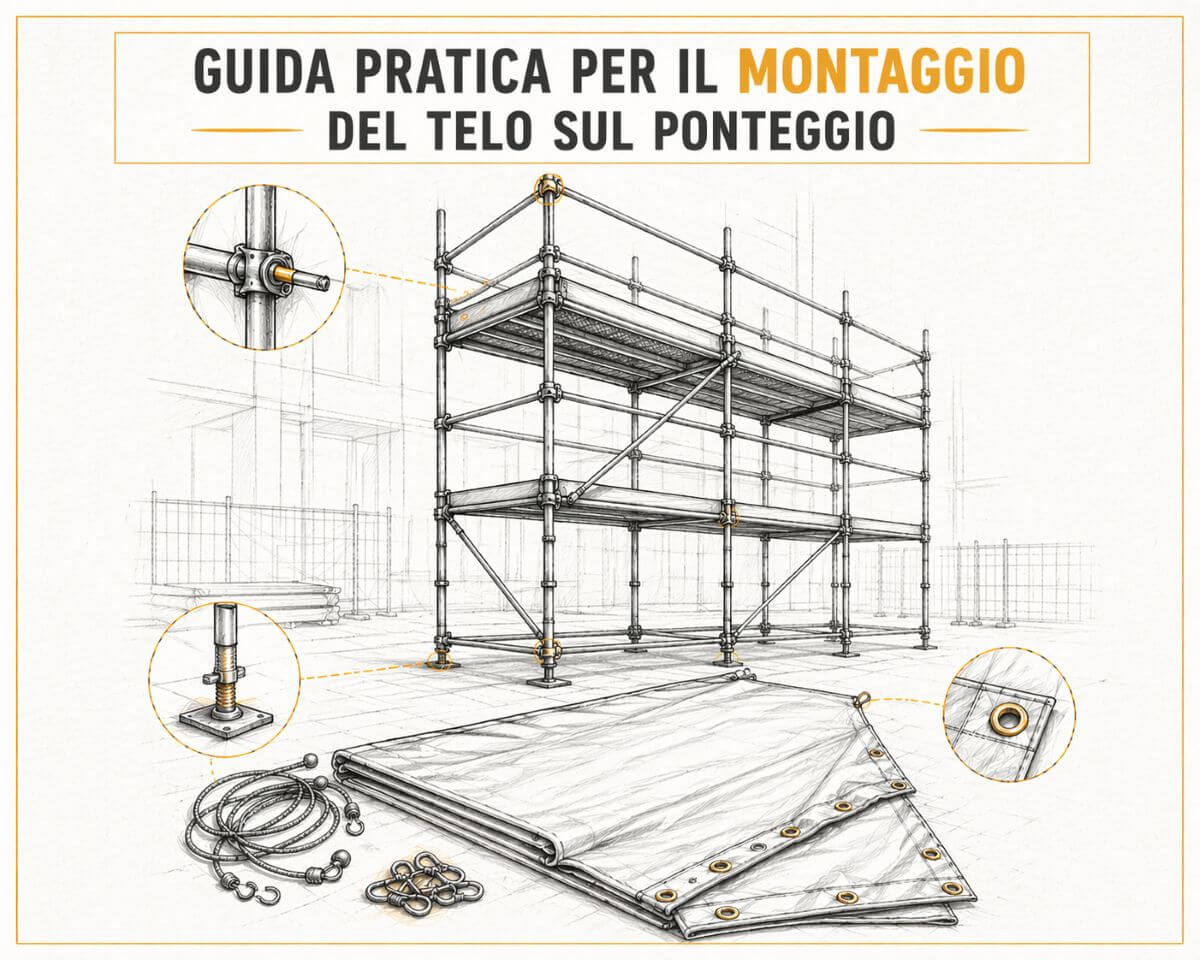
When installing a banner on scaffolding, rushing is often the first cause of mistakes.
To do the job properly, follow this guide. It will help you first look at the structure, check the banner, verify the fixing system, and understand how to proceed in the right way.
These are simple steps, but they make a big difference in getting a more precise installation and a cleaner final result.
In the next paragraphs, you will find exactly this: the checks to do before starting, practical installation tips and some important points to keep in mind during the fixing process.
USEFUL CHECKS BEFORE INSTALLATION

1. Make sure you have all the materials you need
Before you start, make sure you have everything you need for the installation.
Check that you also have the right fixing systems ready, such as bungee cords, and make sure you have enough to complete the job without interruptions.
Preparing everything in advance helps you manage the work better and avoid wasting time.
2. Make sure the banner is the correct one
Check carefully that the banner is the right one for the job you need to do.
Check the size, the installation direction, and the position of the eyelets.
If the banner is large, the installation requires a bit more attention.
In these cases, it’s important that the banner is prepared with the right finishing, for example:
- reinforced edges
- well-distributed eyelets
- longer bungee cords
- and, in more demanding cases, stronger reinforcements in the most stressed areas
These details help support the banner better, distribute the fixing more evenly, and achieve a more stable and cleaner final result.
3. Check the scaffolding carefully before starting
One of the most common mistakes is not considering the protruding corners that stick out from the scaffolding.
Before fixing the banner, take a moment to carefully look at the structure where it will be installed.
Check which points are the easiest to use for fixing, see if there are any obstacles or areas that need more attention, and try to understand right away how to set up the work correctly.
This helps you avoid unnecessary difficulties later on.
4. Check the fixing system you will use
When installing on scaffolding, the fixing system plays an important role.
That’s why it’s useful to make sure it’s suitable for the type of installation you’re working on and that you have enough material to complete the job properly.
All of this helps you tension the banner better and achieve a more accurate and long-lasting result.
5. Avoid unsuitable fixing systems
Before starting, it’s useful to understand which fixing systems are better to avoid or to use with extra care.
For example, wire is not recommended because it doesn’t allow you to properly tension the banner and, over time, it can wear out or rust, affecting the quality of the installation.
To fix the banner, you can use different solutions such as zip ties or bungee cords.
However, bungee cords require special attention: if they are fixed in an “8” shape, they can be harder to install and, especially with large banners, they may cause the banner to sag.
To achieve a neater and more stable result, it is better to use an elastic band for each eyelet, so the tension is distributed more evenly and the fixing is more uniform.
6. Check if the banner requires a standard installation or a more structured solution
Not all banners and not all jobs require the same approach.
That’s why, before starting, it’s important to understand which solution has been planned for the banner you need to install.
This aspect is already defined during the consultation phase, when the most suitable type of banner is evaluated based on the scaffolding, the dimensions, the structure’s characteristics, and the final result you want to achieve.
In some cases, the banner is fixed directly to the existing scaffolding. In other cases, an additional structure may be needed to better support the banner and achieve a more uniform, cleaner, and more refined coverage.
If the banner is large, it’s even more important to understand from the start whether the installation will be done directly on the existing structure or with an additional structure.
Having this clear from the beginning helps you prepare the work better, organize the materials properly, follow the most suitable fixing method, and choose the right solution based on the result you want to achieve.
The two installation solutions for scaffolding

During the consultation phase, the most suitable type of banner for your scaffolding is defined, based on the structure’s characteristics and the result you want to achieve.
This evaluation helps you start with the right materials and handle the installation in a simpler and safer way.
That’s why it’s important to follow the instructions you receive, so you can achieve a result that matches what was planned.
When installing a banner on scaffolding, there are two main solutions: direct installation and installation with an additional structure.
Direct installation


The first solution is installing the banner directly on the existing scaffolding.
In this case, the banner is made to measure and fixed directly to the construction structure, without adding extra elements.
It is the simplest and also the most economical solution, because it allows you to install the banner in a practical way and work directly on the existing structure.
At this stage, however, it is also important to check the side parts of the scaffolding.
If the sides remain too open, air can get behind the front banner, inflate it and create tension on the fixing points.
For this reason, it can be useful to close the sides with windbreak nets or protective nets, in order to reduce air entry and limit the risk of the front banner tearing.
From a visual point of view, this solution does not always allow you to achieve a completely uniform coverage.
In fact, the banner follows the shape of the scaffolding and cannot fully hide edges, recesses or irregularities in the structure.
Direct installation is a good solution when you are looking for a quicker and more convenient system, but you do not need a completely compact aesthetic effect.
Installation with structure

The second solution is installation with an additional structure.
In this case, besides the existing scaffolding, an extra structure is installed, which can extend out by about 10 to 90 centimeters.
This structure is designed to better support the banner, hide the edges, and create a much cleaner and more compact coverage.
Thanks to this solution, you can achieve the so-called “gift wrap effect,” meaning a covering that visually wraps the scaffolding in a more uniform and continuous way.
This is the more expensive option, as it also requires building and installing the additional structure.
At the same time, it’s the solution that allows you to achieve the most precise, uniform, and refined final result.
To get a job done properly, it’s recommended to rely on professionals in the field, because it’s important to carry out an on-site inspection and take measurements accurately.
Scaffolding often has specific details that can’t be evaluated properly without a direct check.
That’s why measurements should be taken by professionals, so the banner can be made to fit the structure and deliver a precise, safe, and consistent final result.
Installing the banner on scaffolding

After checking the banner, the structure, and all the necessary materials, you can move on to the actual installation.
Even at this stage, the final result depends a lot on how you work.
On scaffolding, it’s not enough to fix the banner in a few points and stretch it quickly.
To get a cleaner, more uniform, and stable result, it’s important to follow a clear order and use the most suitable fixing system.
How to start the installation
Before starting, the banner should be laid out properly on the ground at the base of the scaffolding, so you can check it and prepare it correctly.
If the banner is large, it’s important to position it with the top side facing the scaffolding, to make lifting easier.
At this point, the banner can be lifted using a crane or other suitable lifting tools.
If the banner is heavy, it’s essential to distribute the weight properly by using as many eyelets as possible.
You should not lift it by attaching it to only 1 or 2 eyelets, because all the weight would be concentrated in just a few points and the banner could get damaged or be lifted incorrectly.
It’s important to start from the center, otherwise it can become difficult to move the banner once the eyelets are already fixed.
Once this area is well secured, you can continue downward, following a step-by-step order.
This helps you distribute the banner better during installation and keep the tension more even across the entire surface.
Installing it without following a clear order, on the other hand, can lead to wrinkles, uneven tension, or a less clean final result.
The importance of proper tension

During installation, try to tension the banner gradually, little by little, without PULLING IT TO THE MAXIMUM.
Start by fixing the top part, so you can position the banner correctly.
Then fix the side edges, then the bottom, and finally check all four sides.
This way, the banner is guided properly from top to bottom, staying well stretched, neat, and stable across the whole surface.
If some areas are too tight and others too loose, the banner won’t perform well and the result won’t be precise.
That’s why it’s important to keep checking the fixing as you go and make sure the tension is as even as possible on all sides.