
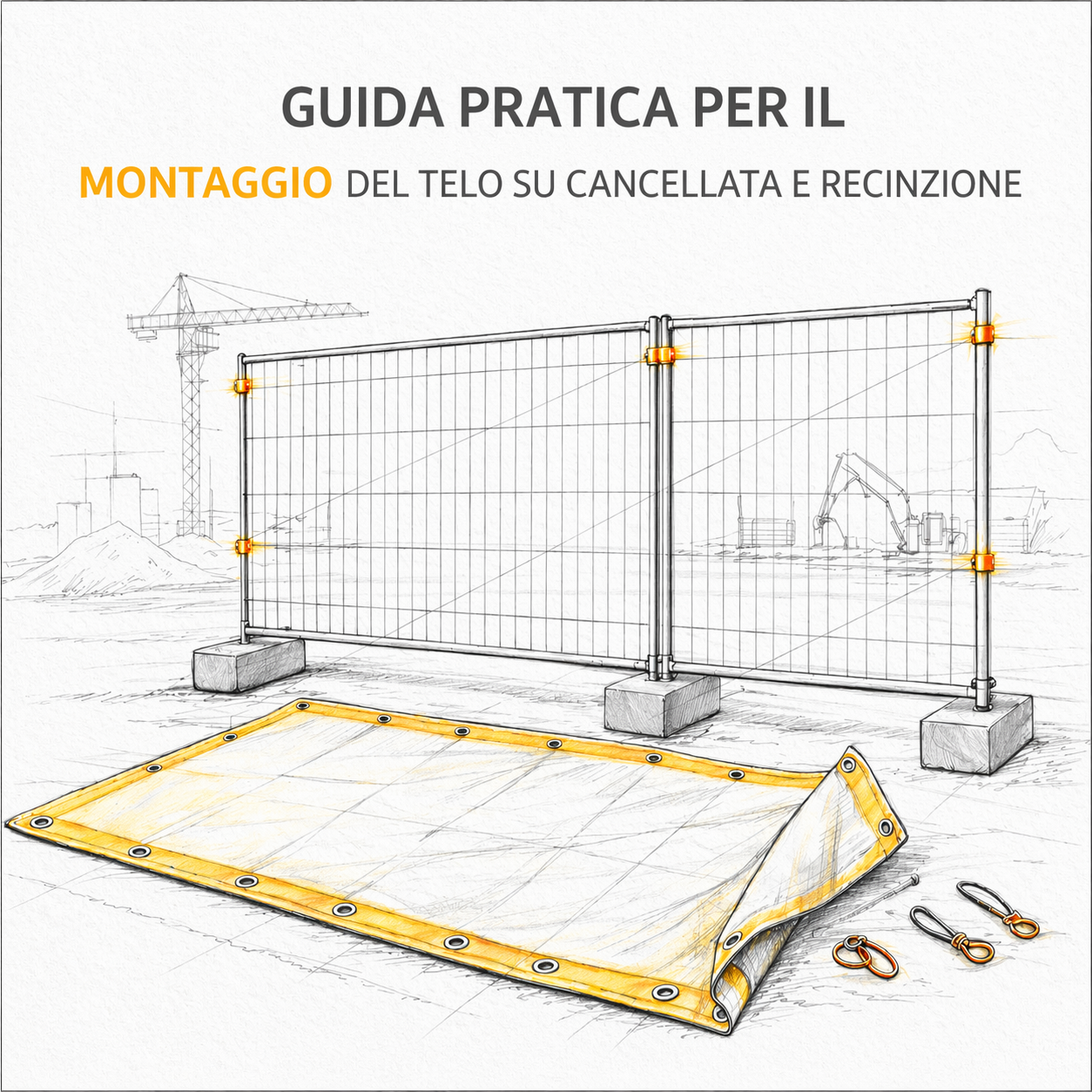
If you are about to install a banner, this guide will help you do it in a correct, neat, and easier way.
At first glance, it may seem like a quick job, but to achieve a clean result it is important to carry out a few useful checks before starting.
In the next paragraphs, you will find the steps to check before installation, useful tips for fixing the banner on gates and site fences, and some common mistakes to avoid so you don’t compromise the final result.
USEFUL CHECKS BEFORE INSTALLATION


Before you start, take a moment.
A good installation does not depend only on how you fix the banner, but also on what you check beforehand.
1. Make sure you have everything you need
Before you begin, make sure you have all the materials needed for the installation.
Depending on the type of setup, you should have the banner, zip ties, or other fixing systems with you.
Doing this check right away helps you avoid wasting time and makes the work smoother.
2. Check the banner carefully before fully opening it
Make sure the banner is the correct one and carefully check how it should be positioned.
Also check that it matches the preview you received, that all the eyelets are present, and that it has not been damaged during transport or unpacking.
Before fixing it, it is useful to understand the correct direction and check that there are no folds, marks, or visible damage.
If you notice any issue, send a photo to your consultant right away.
3. Check the structure where it will be installed
Whether it is a gate or a fence, carefully check the surface where you will fix the banner
Look for any obstacles, protrusions, easier fixing points, or areas that require more attention.
It is also important to check the stability of the structure to prevent possible tipping.
In 99% of cases, the main difference is not the type of banner used, but how the gate or fence is fixed and anchored.
For this reason, it is essential to make sure the structure is properly installed before proceeding with the banner installation.
4. Prepare the work area
When you are about to lay out the banner, make sure you have enough space to work in a comfortable and organized way.
A well-prepared area helps you position the banner better from the start and work more precisely.
5. Lay out the banner carefully
If the banner is large, place it on the ground and spread it out properly in the installation area.
This step allows you to check the measurements, direction and position more accurately, avoiding alignment mistakes or installation work that has to be redone.
When the banners are numbered, it is important to take them out of the packaging and check the indicated sequence.
At that point, we recommend separating them and placing each piece in front of the gate, following the correct installation order.
In this way, you work more neatly, reduce the risk of mistakes, and make the fixing process much easier and faster.
How to get a PERFECT installation for your EDILTELO


A properly installed banner improves visibility, performs better over time, and reduces the risk of excessive movement or tearing.
For fixing, you can use electrician cable ties or elastic tensioners.
If the area is particularly exposed to wind, elastic fixings are the most suitable choice, because they allow the banner to have a small controlled movement and help reduce tension on the eyelets.
During installation, make sure you do not leave the cable ties too loose.
If the banner is too loose, it tends to inflate and create the classic sail effect, increasing stress on the fixing points.
To achieve a more stable and tidy result, guide the banner properly along the entire gate and distribute the fixings evenly.
Use all the available eyelets
It is essential to use all the eyelets, without skipping any.
This helps distribute the tension better across the entire surface of the banner, avoiding areas that are too tight and others that are too loose.
The result is a banner that is firmer, cleaner to look at and less exposed to deformation or excessive stress.
However, a few simple precautions are enough to improve the result:
- Tension it evenly.
- Fix it at all points, especially at the corners.
- Do not leave loose areas that can catch air.
This alone can greatly change how the banner behaves when the wind arrives.
But even with a well-installed banner, when a strong gust arrives, the problem can be something else.
How to increase the stability of the structure
Very often, the real critical point is at ground level.
If the bases are light, low, poorly fixed, or simply placed without proper anchoring, the structure can lose stability at the first strong gust.
And that’s when the fence starts to move, shift, or in the worst cases, tip over.
To increase stability, especially in more exposed areas, you can use rear supports, meaning angled braces that go from the fence down to the ground.
Questa soluzione rende tutta la struttura più stabile e meno soggetta alla spinta del vento.
Another common solution is using concrete weights.
By adding weight at the base, the fence stays more stable and the risk of movement or instability is reduced.
In some cases, tube clamps are also used, which are helpful for fixing the construction fence more securely to a scaffold tube or a metal support.
In this way, the structure remains more solid and better resists movements caused by the wind.
So, if the fence is stable, you can use reinforced zip ties.
If the installation area is very exposed to wind, it is better to use elastic fixings.
In both cases, avoid leaving the fixings too loose and remember to use all the available eyelets.
But don’t focus only on the banner.
Always check the stability of the structure, the type of base, and whether additional supports are needed, such as rear braces, weights, or fixing clamps.
This is what helps you achieve a proper installation and a final result that is safer, more organized, and more stable over time.
Installing the banner on a fence


If you need to install a banner on a fence, the first thing to do is carefully check the structure you will be working on.
A fence can be more exposed to wind and more subject to movement
For this reason, it is important to make sure right away that it is well positioned, stable, and properly fixed.
If the structure is not stable, installing the banner without doing this check first can increase movement and make the result less stable and less neat.
When installing the banner on a fence, you need to pay close attention to how you distribute the fixings.
The banner must follow the entire structure properly, without being too tight in some areas and too loose in others.
In this case as well, it is important to use all the available eyelets.
This helps distribute the tension more evenly and prevents the load from concentrating only in certain points of the fence.
Another useful tip is not to stretch the banner too much.
Too much tension can put stress not only on the banner and the eyelets, but also on the structure itself.
If it is too loose, the wind can make it inflate and create a sail effect, increasing the pressure on the fence.
The goal is to achieve a balanced fixing.
The banner should be well positioned, neat, and evenly distributed, without being too tight or too loose.
For this reason, when installing a banner on a fence, it is important to work carefully, check the stability of the structure, and distribute the fixings as evenly as possible.
This helps you achieve a cleaner result, more resistant and safer over time.
Common mistakes to AVOID


❌ Starting the installation too quickly, without first checking the position, direction and structure.
❌ Always fixing the banner in the same way, without considering the type of support.
❌ Not checking whether the structure is stable.
❌ Leaving the banner too loose, risking a messy result that is more exposed to the wind.
❌ Tensioning the banner too much, creating creases, deformation or incorrect tension.
❌ Finishing the installation without doing one final general check on all sides.
Now that you have seen which checks to do before installation and which mistakes to avoid, the next step is to choose a banner that also works well from an image point of view.
EDILTELO was created precisely for this: to help you cover, delimit and personalize your construction site in a more professional way.
On the website, you can see examples, features and solutions designed for gates and construction site fences.
👉 Visit EDILTELO and discover how to improve the image of your next construction site.